Modificaton of the load
To see the effect of a changing load while all other parameters are constant, the following code is used in LTspice:
.param RL = 5 Rload n2 0 {RL} .step param RL list 2 5 10 20 50 100
This will overlay the results while the load changes on each step. The table below shows the simulated results. Because only RL changes and all other parameters remain constant, this analysis also captures the system’s behaviour when changing the quality factor of the receiving side.
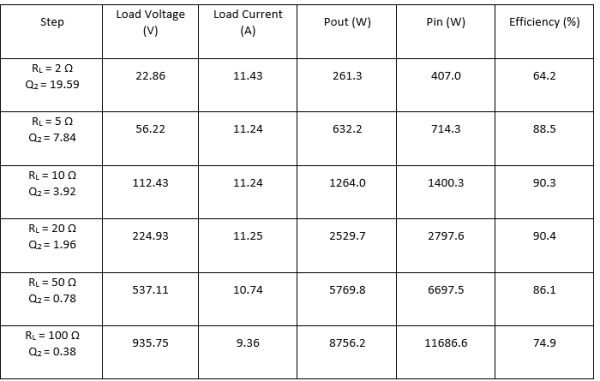
Like mentioned earlier, when the quality factor is high, the efficiency will rise because of the low resistive losses in a resonant circuit. At the same time, it makes the system more sensitive to changes in frequency. This is clearly illustrated from the results shown in the table above. A lower RL also means that the current will become larger, increasing the unwanted conduction losses.
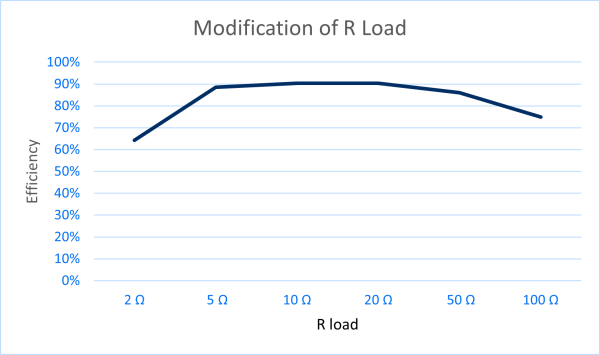
At a load of 2 Ω, the system has a high Q-factor of 19.59, meaning the resonance is very narrow. Because of this, it is very sensitive to changing frequency, which shows the low efficiency of 64.2%. When the load rises to 5 Ω, the Q-factor decreases to 7.84, resulting in a wider resonance. As the resonance broadens, the efficiency improves significantly to 88.5%. The system becomes more stable and less sensitive to frequency shifts, allowing for better power transfer.
The optimal condition for this system is when RL is 10 and 20 Ω. Both resulting in an efficiency above 90%. The Q-factor is reduced and at the same time, the resonance becomes wider, meaning the system is more stable and less sensitive to small frequency shifts, allowing for efficient power transfer with less risk of instability or power loss. When the load resistance increases to 50 Ω, the Q-factor drops to 0.78, leading to a very broad resonance. As a result, the system becomes less selective and starts to deviate from the optimal power transfer condition. The efficiency decreases to 86.1%, due to poor impedance matching. At a load of 100 Ω, the Q-factor is very low at 0.38, and the resonance becomes extremely broad. Although the wider bandwidth makes the system less sensitive to frequency variations, it also limits the ability to concentrate energy transfer at the resonant frequency. This means that less power is delivered to the load and at the same time, the efficiency drops down below 80%.
All the above can be partly explained by the maximum power transfer theorem, otherwise known as Jacobi’s Law. When the load resistance is increased beyond the source resistance, the efficiency improves because a larger portion of the source power is delivered to the load. However, the actual power received by the load decreases since the overall circuit resistance rises. Conversely, if the load resistance is reduced below the source resistance, efficiency drops because more power is lost in the source. Although the total power dissipated in the circuit goes up due to the lower total resistance, the power dissipated in the load itself becomes smaller. In other words, there is an optimal resistance to maximise the efficiency and one to maximise the power transfer.

In conclusion, the efficiency of the system is highest when the load is optimal. In this case when RL is 10 or 20 Ω. When the load decreases, the Q-factor at the receiving side will rise and the systems becomes more sensitive to frequency changes. It also results in higher currents in the system. This will both result in a drop in efficiency. When the load increases, the Q-factor at the receiving side will decrease and the system becomes less sensitive to frequency changes. This also means it’s harder for the system to concentrate energy transfer at the resonance frequency, resulting in efficiency drops.