Modification of the frequency
To see the effect of changing the resonant frequency, two separate analyses are conducted:
- Changing the frequency while maintaining the other parameters.
- Changing the frequency while maintaining resonance by simultaneously adjusting the capacitors.
Following code is used in LTspice:
PULSE(-200 200 0 1n 1n {1/(2*f)} {1/f}) .step param f list 10k 15k 20k 25k 30k .param C1 = 1 / ( (2 * pi * f)2 * L1 ) .param C2 = 1 / ( (2 * pi * f)2 * L2 )
Frequency modification without adjusting capacitors
The frequency will be swept from 10 kHz to 30 kHz while maintaining all other parameters. the table below shows the simulated results.

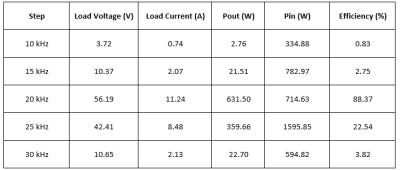
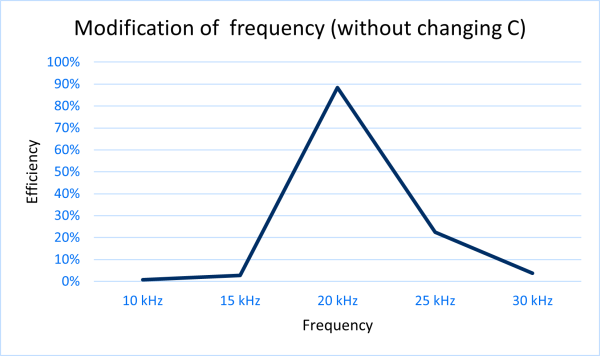
The results clearly indicate that an IPT system is the most efficient at resonant frequency, in this case at 20 kHz. When the frequency moves away from this point, the efficiency decreases rapidly. For instance, an efficiency of 0.83% is simulated for a frequency of 10 kHz and a 3.82% efficiency for a frequency of 30 kHz.
Frequency modification with adjusting capacitors
The frequency will be swept from 10 kHz to 30 kHz while maintaining all other parameters. The table below shows the simulated results.
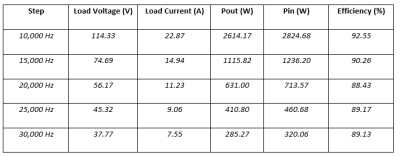
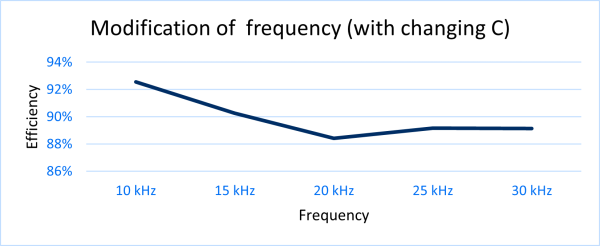
It is clear that the system has the highest efficiency at resonance frequency. However, despite being at resonance frequencies and having a rising quality factor, the efficiency drops with rising frequency. This is due to the skin effect and other parasitic losses.