Modification of the Coupling Coefficient
To see the effect of changing coupling coefficient, k will be altered while the other parameters stay constant.
The following code is used in LTspice:
.step param k list 0.1 0.2671 0.40 0.55 0.70 0.85 1
This will overlay simulation results while sweeping the k parameter from 0.1 to 1. Changing k in the physical setup can be done by changing the distance between the coils, changing the alignment of the coils or changing the size/shape of the coils. Below fogures show the simulated results with changing coupling coefficient.
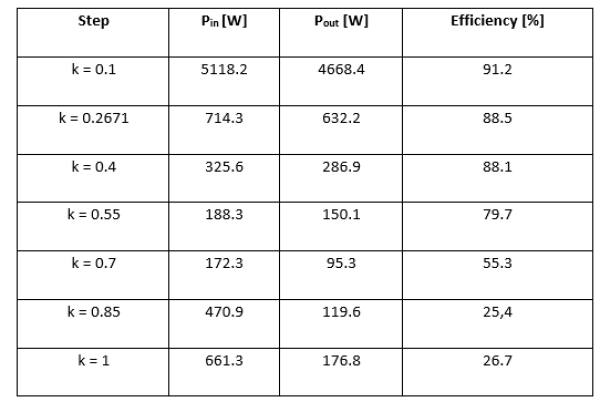

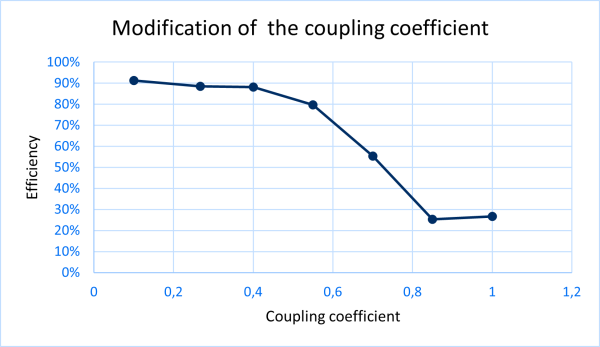
At a coupling coefficient of 0.1, the efficiency is the highest. Despite the weak coupling, the transmitter circuit operated efficiently because the reflected impedance from the receiving circuit was minimal. This maintained a proper resonance. Figure 63 shows that, for a coupling coefficient of 0.1, that Vload a smooth and stable sinusoidal waveform is produced.
The efficiency remained high but started to drop with a k value of 0.55. From this point, the system became over-coupled. This means a portion of the impedance is reflected back to the primary side, detuning it and the resonance could no longer be maintained. This leads to distorted/lower output voltages and therefore reduced efficiency.
At a k value of 1, the input power was again higher, but because the system was not tuned for this, only a small portion reached the load. This results in a low efficiency and waveform distortion. These results confirm that higher coupling does not necessary guarantee better performance. The system must be retuned when k increases. Otherwise, efficiency drops due to resonance mismatch and reactive losses.